Microservices With .NET
In recent years, microservices architecture has become increasingly popular among software developers. The flexibility and scalability of this approach are particularly appealing to businesses that need to quickly adapt to changing market conditions. We explain what microservices are, the benefits of using them, and how they work in .NET to streamline your applications.
What are Microservices?
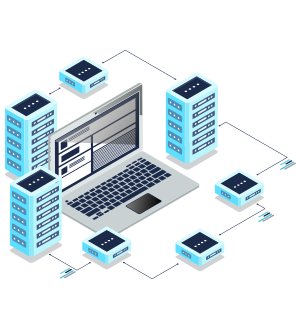
Microservices are a software development approach that involves breaking down a large, monolithic application into small, independent, and loosely coupled services that can be developed, deployed, and scaled independently.
Each microservice focuses on a specific business function and communicates with other microservices through well-defined APIs. Microservices are designed to be agile, scalable, and fault-tolerant, making them ideal for building complex and distributed systems that can handle large amounts of data and traffic.
Significant Benefits of Using Microservices
There are many benefits to using microservices in software development, including increased agility and resilience.

Tightly Scoped
Focused on a specific business function and designed to be small and self-contained, enabling faster development and testing.

Strongly Encapsulated
Clear separation of concerns between different services, making it easier to modify code without affecting the system.

Loosely Coupled
Services communicate through well-defined APIs so changes in one service do not disrupt or break other services.

Independently Deployable
Deploy and update individual services without needing to redeploy the entire monolithic system.
Independently Scalable
Scale high-demand microservices independently to optimize server resource usage and infrastructure cost.
Components of Microservices Architecture
Microservices architecture is a way of designing software applications as a collection of small, independent services that communicate with each other over lightweight protocols.
Microservices
Microservices are the core building blocks, each providing a specific business capability independently.
Containers
Lightweight executable packages containing application code, dependencies, and runtime settings (Docker/Kubernetes).
Service Mesh
Dedicated infrastructure layer for managing service-to-service communication, load balancing, and mutual TLS encryption (Istio/Envoy).
Service Discovery
Automatically locates network IP/port details of active service instances dynamically without hardcoding static URLs (Consul/Eureka).
API Gateway
Reverse proxy acting as a single entry point for clients, managing authentication, rate limiting, and request routing (Ocelot/YARP/Kong).
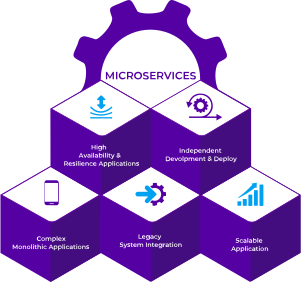
Microservices Use Cases & Topology
Get Started With Microservices Today!
If you are interested in using microservices in your .NET applications, follow these fundamental steps:
Define Business Capabilities
Identify the distinct business capabilities that your application needs to provide.Break Down Application
Decompose your monolithic application into smaller, self-contained microservices.Choose Tech Stack
Select the best frameworks, gRPC/HTTP protocols, and database storage for each service.Design APIs & Contracts
Define clear OpenAPI or gRPC protobuf contracts that each microservice exposes.Deploy Microservices
Deploy services using CI/CD pipelines to container platforms like Azure AKS or AWS EKS.Test & Monitor
Incorporate distributed tracing (OpenTelemetry) and centralized logging (ELK/Seq).AI-Driven Microservices Architecture
Integrate autonomous AI agents, distributed vector search nodes, and intelligent event-driven processing into your microservices ecosystem for enterprise-grade scalability.
Autonomous AI Microservices Agents
Build decoupled gRPC microservices dedicated to specific AI tasks — document parsing, sentiment scoring, and text generation — functioning as autonomous worker nodes.
Distributed Event-Driven AI Messaging
Orchestrate asynchronous AI batch inference using Apache Kafka or RabbitMQ event streams, ensuring main HTTP thread operations are never blocked.
Elastic Microservices Scaling for LLMs
Utilize KEDA (Kubernetes Event-driven Autoscaling) to automatically scale AI worker pods up or down based on incoming LLM request queue depth.
API Gateway AI Rate Limiting & Guardrails
Enforce central API Gateway policies that govern LLM token usage, prevent prompt injection, and cache duplicate AI query responses to optimize costs.
Distributed Vector Search Microservices
Isolate vector embedding generation and semantic indexing into dedicated microservices backed by Qdrant, Pinecone, or Milvus clusters.
Circuit Breakers & AI Resiliency
Implement Polly circuit breaker patterns in .NET microservices to handle AI API rate limits or outages gracefully with automatic fallback models.
Ready to Architect Scalable .NET Microservices Solutions?
Discuss about your project. Our team will respond with a
tailored proposal as soon as possible.
Frequently Asked Questions
While there are many benefits to using microservices, there are also some challenges to be aware of:
- Increased complexity: Microservices architecture has more moving parts to manage than a monolithic application.
- Communication overhead: Communication over a network can affect latency if not optimized.
- Data consistency: Managing separate data stores per microservice requires distributed consistency patterns.
- Deployment and testing: Continuous deployment pipelines and integration testing become vital.
Yes, .NET provides many tools and frameworks for building microservices, including .NET Core / .NET 8, Docker, Kubernetes, and Azure. Additionally, open-source libraries like MassTransit and YARP simplify building microservices in .NET.
No, microservices can be built using a variety of programming languages. However, choosing a high-performance framework like .NET or Node.js is ideal for building scalable and distributed systems.
You can deploy microservices on-premises or in the cloud using container orchestration systems like Kubernetes. Deploying microservices in the cloud (Azure, AWS, GCP) provides additional scalability, managed Kubernetes, and serverless options.